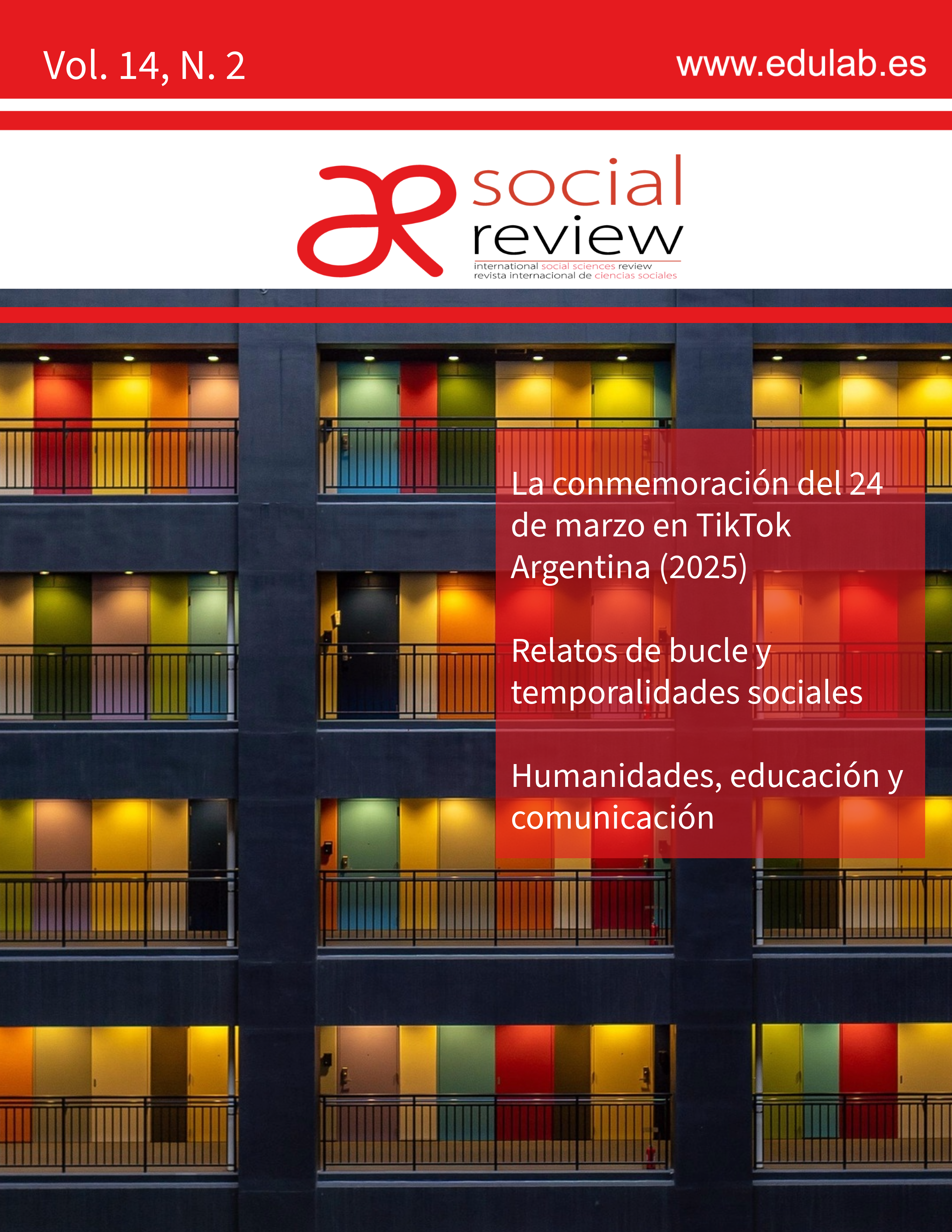
La conmemoración del 24 de marzo en TikTok Argentina (2025)
Producción, circulación y recepción de las narrativas memoriales en entornos digitales
DOI:
https://doi.org/10.62701/revsocial.v14.5561Palabras clave:
Memoria colectiva, Plataforma digital, Participación del público, Dictadura, Semiótica, DesinformaciónResumen
Este artículo analiza la producción, circulación y recepción de las narrativas sobre el aniversario del último golpe de Estado en Argentina en 1976 en TikTok, en un contexto donde los algoritmos, los formatos breves y la viralización reconfiguran las formas de recordar el pasado reciente. A partir de videos publicados el 24 de marzo de 2025, identificados mediante hashtags conmemorativos, se examinan recursos visuales e interacciones. La metodología articula herramientas de la sociosemiótica y el análisis de contenido. Los resultados indican tensiones entre matrices interpretativas heredadas del pasado, pedagogía, banalización y discursos negacionistas, que configuran un terreno de disputa simbólica.
Descargas
Estadísticas globales ℹ️
|
229
Visualizaciones
|
123
Descargas
|
|
352
Total
|
|
Citas
Acuña, C., & Smulovitz, C. (1995). Militares en la transición argentina: del gobierno a la subordinación constitucional. En C. H. Acuña (comp.). La nueva matriz política argentina (s.p.). Nueva Visión.
Baltar-Moreno, A. (2022). Redes sociales digitales como lugares de memoria: diálogos ciudadanos a través de la fotografía en Facebook. Icono 14, Revista de Comunicación y Tecnologías Emergentes, 20(2), 1–23. https://doi.org/10.7195/ri14.v20i2.1880 DOI: https://doi.org/10.7195/ri14.v20i2.1880
Borrelli, M. (2010). ¿Víctimas, héroes o cómplices? Memorias en disputa sobre el rol de la prensa durante la última dictadura militar. AVATARES de la Comunicación y la Cultura, 1, 1-17. http://ppct.caicyt.gov.ar/index.php/avatares/issue/view/Memoria
Crenzel, E. (2008) La historia política del Nunca Más. Siglo XXI.
Da Silva Catela, L. (22 de marzo de 2024). Son 30.000. Instituto de Antropología de Córdoba. IDACOR. https://idacor.conicet.gov.ar/son-30mil/
Da Silva Catela, L. (2002). El mundo de los archivo. En L. Da Silva Catela, & E. Jelin (comps.). Los archivos de la represión: documentos, memoria y verdad (pp.196-219). Siglo XXI.
Feld, C. (2002). Del estrado a la pantalla. Las imágenes del juicio a los excomandantes en Argentina. Buenos Aires: Siglo XXI.
Franco, M. (2018) El final del silencio. Dictadura, sociedad y derechos humanos en la transición (Argentina, 1979-1983). Fondo de Cultura Económica.
Franco, M. y Levín, F. (2007). Historia reciente. Perspectivas y desafíos para un campo en construcción. Paidós.
Gago, M. P. (2025). La rememoración mediática del 24 de marzo durante la transición democrática argentina. En P. Porto López, S. Gastaldi, M. E. Bitonte, F. Fernández y G. Simón, Intervenciones semióticas: focalizar, transformar, expandir: actas 11° Congreso Argentino de Semiótica (pp. 1457–1471). Libros de Crítica.
Gonzales García, C., & Vásquez Romero, C. A. (2025). Estudios de Memoria y Medios Digitales: El caso de «Hasta que la vida nos separe» de Ojo Público. Question/Cuestión, 3(81), 1-20. https://perio.unlp.edu.ar/ojs/index.php/question/article/view/8436 DOI: https://doi.org/10.24215/16696581e1011
Halbwachs, M. (2004). La memoria colectiva. Prensas Universitarias de Zaragoza.
Hernández-Sampieri, R., Fernández Collado, C., & Baptista Lucio, P. (2014). Metodología de la investigación. McGrawHill.
Jelin, E. (2002). Los trabajos de la memoria. Siglo XXI.
Lvovich, D., & Bisquert, J. (2008) La cambiante memoria de la dictadura: discursos públicos, movimientos sociales y legitimidad democrática. Universidad Nacional de Quilmes/Biblioteca Nacional.
Raíces, E. (2021). Deber de memoria. El informe por entregas «Miseria de la prensa del proceso» de la revista Humor. Periodismo, ética y denuncia en la escena postdictatorial argentina (1984). Kamchatka. Revista De análisis Cultural., (18), 343–370. https://doi.org/10.7203/KAM.18.20501 DOI: https://doi.org/10.7203/KAM.18.20501
Riffe, D., Lacy, S., & Fico, F.G. (2008). Analyzing media messages. Using Quantitative Content Analysis in Research. Lawrence Erlbaum Associates.
Segre, C. (1985). Principios de análisis del texto literario. Grijalbo.
Steimberg, O. (1993). Semiótica de los medios masivos. Atuel.
Van Dijck, M. J. (2004). Mediated memories: Personal cultural memory as object of cultural analysis. Continuum: Journal of Media & Cultural Studies, 18(2), 261–277. https://doi.org/10.1080/1030431042000215040 DOI: https://doi.org/10.1080/1030431042000215040
Verón, E. (1993). La semiosis social. Fragmentos para una teoría de la discursividad. Gedisa.
Vitale, A. (2015). Cómo pudo suceder. Prensa escrita y golpismo en la Argentina (1930-1976). Eudeba.
Descargas
Publicado
Cómo citar
Número
Sección
Licencia
Derechos de autor 2026 María Paula Gago

Esta obra está bajo una licencia internacional Creative Commons Atribución-SinDerivadas 4.0.
Los autores/as que publiquen en esta revista aceptan las siguientes condiciones:
- Los autores/as conservan los derechos de autor.
- Los autores/as ceden a la revista el derecho de la primera publicación. La revista también posee los derechos de edición.
- Todos los contenidos publicados se regulan mediante una Licencia Atribución/Reconocimiento-SinDerivados 4.0 Internacional. Acceda a la versión informativa y texto legal de la licencia. En virtud de ello, se permite a terceros utilizar lo publicado siempre que mencionen la autoría del trabajo y a la primera publicación en esta revista. Si transforma el material, no podrá distribuir el trabajo modificado.
- Los autores/as pueden realizar otros acuerdos contractuales independientes y adicionales para la distribución no exclusiva de la versión del artículo publicado en esta revista (p. ej., incluirlo en un repositorio institucional o publicarlo en un libro) siempre que indiquen claramente que el trabajo se publicó por primera vez en esta revista.
- Se permite y recomienda a los autores/as a publicar su trabajo en Internet (por ejemplo en páginas institucionales o personales), una vez publicado en la revista y citando a la misma ya que puede conducir a intercambios productivos y a una mayor y más rápida difusión del trabajo publicado (vea The Effect of Open Access).