
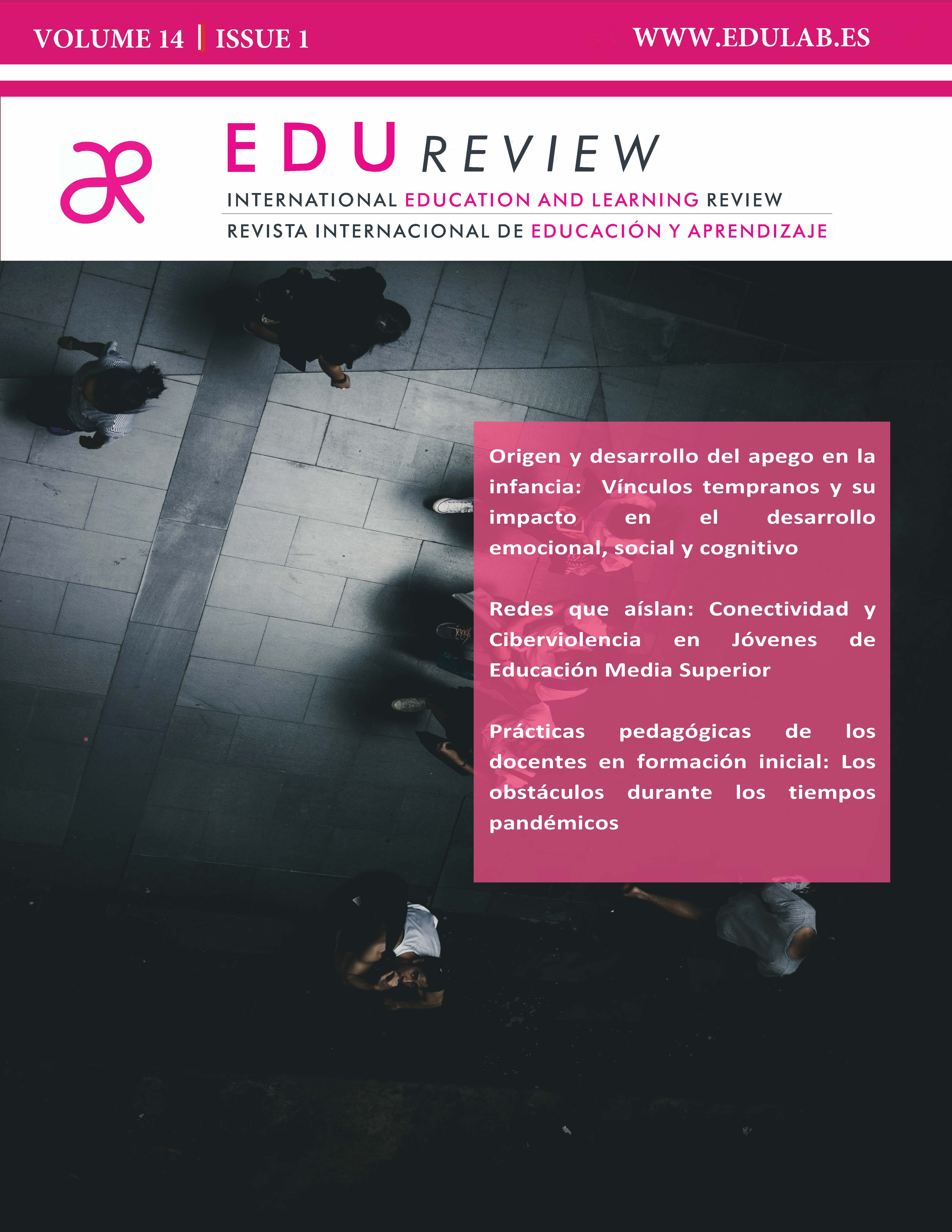
Origin and Development of Attachment in Childhood
Early Bonds and their Impact on Emotional, Social, and Cognitive Development
DOI:
https://doi.org/10.62701/revedu.v14.5476Keywords:
Attachment, Caregivers, Mental health, Emotional regulation, Affective bond, Socioemotional development, Philosophy of mindAbstract
Attachment is an affective bond that plays a fundamental role in children's emotional, social, and cognitive development, emerging through interaction with primary caregivers. This article reviews the biological and relational factors that determine its formation, as well as the impact of caregiver sensitivity, emotional attunement, and mental models. It analyzes the consequences of different attachment styles on self-esteem, emotional regulation, and social relationships. The importance of early detection of dysfunctional patterns is emphasized, along with the promotion of secure bonds as a key preventive strategy to foster emotional well-being and mental health during childhood.
Downloads
Global Statistics ℹ️
|
802
Views
|
497
Downloads
|
|
1299
Total
|
|
References
Ávalos Martínez, E. G. (2024). La importancia de fomentar el vínculo de apego en las familias a través del programa de expansión de la educación inicial visitas a los hogares modalidad no escolarizada en México. Psike, 13(1), 1–17.
Bălan, C., & Lupu, D. (2025). The need for better attachment bonds between institutional caregivers and institutionalized children: A systematic review. Behavioral Sciences, 15(3), 245. https://doi.org/10.3390/bs15030245 DOI: https://doi.org/10.3390/bs15030245
Cantero, M. J. (2003). Pautas tempranas del desarrollo afectivo y su relación con la adaptación al centro escolar. Informació Psicològica, (82), 3–13.
Estévez, E., Martínez, B., & Jiménez, T. I. (2009). Las relaciones sociales en la escuela: el problema del rechazo escolar. Psicología Educativa, 15(1), 45–60.
Fonagy, P. (2004). Teoría del apego y psicoanálisis. Barcelona: Espaxs S.A.
García Sánchez, R., & Mederos Castellano, S. (2025). Programación didáctica en educación ambiental y naturalista desde una perspectiva evolucionista. EDU REVIEW: International Education and Learning Review, 13, 169–183. DOI: https://doi.org/10.62701/revedu.v13.5436
García Sánchez, R., & Romero de los Reyes, L. (2021). Desarrollo del apego: una mirada retrospectiva. Revista Egle, (18), 43–68.
García Sánchez, R., Cuesta Condoy, L. V., & Pérez Bravo, S. (2024). Influencia del tipo de apego en el niño. Canarias Pediátrica, 47(1), 39–45.
González Santana, S. (2022). Antecedentes del apego, tipos y modelos operativos internos. Revista de Psiquiatría Infanto-Juvenil, 39(2). https://doi.org/10.31766/revpsij.v39n2a2 DOI: https://doi.org/10.31766/revpsij.v39n2a2
López, S. (2024). Bases teóricas del apego infantil y su aplicación clínica. Anales de Psicología, 40(1), 15–27.
Milozzi, S., & Marmo, J. (2022). Revisión sistemática sobre la relación entre apego y regulación emocional. Psicología Unemi, 6(11), 70–86. DOI: https://doi.org/10.29076/issn.2602-8379vol6iss11.2022pp70-86p
Mortazavizadeh, Z., Göllner, L., & Forstmeier, S. (2022). Emotional competence, attachment, and parenting styles in children and parents. Psicologia: Reflexão e Crítica, 35(6). https://doi.org/10.1186/s41155-022-00208-0 DOI: https://doi.org/10.1186/s41155-022-00208-0
Paredes, A. (2020). La institucionalización y su impacto en el desarrollo infantil. Psicologia: Reflexão e Crítica, 33(2), 1–10.
Ren, Q., Topakas, A., & Patterson, M. (2024). Attachment and self-regulation in the workplace—a theoretical integration. Frontiers in Psychology, 15, 1387548. DOI: https://doi.org/10.3389/fpsyg.2024.1387548
Rivas Martínez, D. A. (2021). El rol del apego en el desarrollo del lenguaje y la comunicación a lo largo de la vida. Psike, 10(1), 79–93.
Downloads
Published
How to Cite
Issue
Section
License
Copyright (c) 2026 Authors retain copyright and transfer to the journal the right of first publication and publishing rights

This work is licensed under a Creative Commons Attribution-NoDerivatives 4.0 International License.
Those authors who publish in this journal accept the following terms:
-
Authors retain copyright.
-
Authors transfer to the journal the right of first publication. The journal also owns the publishing rights.
-
All published contents are governed by an Attribution-NoDerivatives 4.0 International License.
Access the informative version and legal text of the license. By virtue of this, third parties are allowed to use what is published as long as they mention the authorship of the work and the first publication in this journal. If you transform the material, you may not distribute the modified work. -
Authors may make other independent and additional contractual arrangements for non-exclusive distribution of the version of the article published in this journal (e.g., inclusion in an institutional repository or publication in a book) as long as they clearly indicate that the work was first published in this journal.
- Authors are allowed and recommended to publish their work on the Internet (for example on institutional and personal websites), following the publication of, and referencing the journal, as this could lead to constructive exchanges and a more extensive and quick circulation of published works (see The Effect of Open Access).