
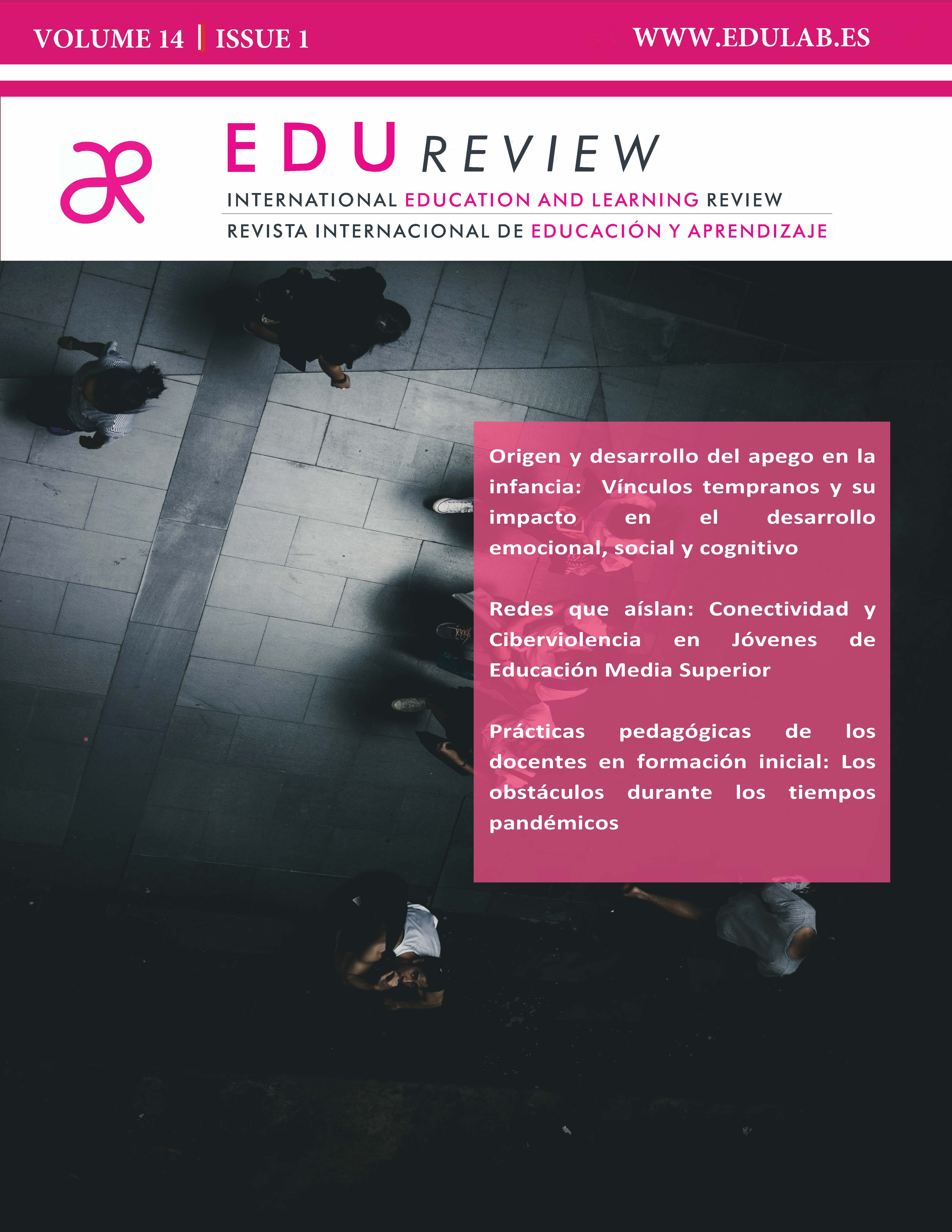
Isolating Networks
Connectivity and Cyberviolence among Upper Secondary Students
DOI:
https://doi.org/10.62701/revedu.v14.5522Keywords:
competencies, Cibyerviolence, Bullying, youth activity, upper secondary educationAbstract
This study aimed to identify connectivity practices, cyberviolence, and their effects among students enrolled in public upper secondary education, to provide evidence for the design of preventive actions. A quantitative methodological design was employed through a questionnaire administered to 279 students aged 15 to 18, from different semesters and school shifts. The analysis focused on technology use, digital competencies, and experiences of online aggression. The results reveal high levels of connectivity, difficulties in regulating technology use, and multiple forms of cyberviolence, highlighting the need for comprehensive educational interventions.
Downloads
Global Statistics ℹ️
|
182
Views
|
162
Downloads
|
|
344
Total
|
|
References
Asociación Mexicana de Internet. (2023). 19° estudio sobre los hábitos de usuarios de internet en México. https://www.asociaciondeinternet.mx
Belsey, B. (s.f.). Belsey, B. (s.f.). Cyberbullying: An emerging threat to the “always on” generation. http://www.billbelsey.com/?p=1827
Bosch, E., Ferrer, M. V., García, M. E., Ramis, M. C., Mas, M. C., Navarro, C., y Torrens, G. (2007). Del mito del amor romántico a la violencia contra las mujeres en la pareja. Instituto de la Mujer. https://www.inmujeres.gob.es/publicacioneselectronicas/documentacion/Documentos/DE0055.pdf
Braun, V., y Clarke, V. (2006). Using thematic analysis in psychology. Qualitative Research in Psychology, 3(2), 77–101. https://doi.org/10.1191/1478088706qp063oa DOI: https://doi.org/10.1191/1478088706qp063oa
Carrión Candel, E. (2020). El uso de las TIC en la integración educativa: el bullying, componentes y diferencia de género. EDMETIC, Revista de Educación Mediática y TIC, 9(1), 126–148. https://doi.org/10.21071/edmetic.v9i1.12110 DOI: https://doi.org/10.21071/edmetic.v9i1.12110
Castelli Olvera, A. K. (2020). Campañas contra la violencia de género: los medios en la construcción del imaginario social en jóvenes de educación media superior. Edähi Boletín Científico de Ciencias Sociales y Humanidades del Instituto de Ciencias Sociales y Humanidades, 8(16), 30 38. https://doi.org/10.29057/icshu.v8i16.5853 DOI: https://doi.org/10.29057/icshu.v8i16.5853
Daza, P., Novy, D. M., Stanley, M. A., & Averill, P. (2002). The Depression Anxiety Stress Scale-21: Spanish translation and validation with a Hispanic sample. Journal of Psychopathology and Behavioral Assessment, 24(3), 195–205. https://doi.org/10.1023/A:1016014818163 DOI: https://doi.org/10.1023/A:1016014818163
Domínguez Pozos, F. de J., Delhumeau Rivera, S., y Rentería Díaz, I. D. (2024). Jóvenes, redes sociales y ciudadanía: Caso de estudiantes de educación media superior en Baja California. Edähi Boletín Científico de Ciencias Sociales y Humanidades del ICSHu, 12(Especial 2), 30-41. https://doi.org/10.29057/icshu.v12iEspecial2.13315 DOI: https://doi.org/10.29057/icshu.v12iEspecial2.13315
Edähi. Boletín Científico de Ciencias Sociales y Humanidades del ICSHu. (2024). Vol. 12, No. Especial 2, 30–41.
El Economista. (2022, 20 de septiembre). 2 de cada 10 estudiantes en México sufren acoso escolar. https://www.eleconomista.com.mx/politica/2-de-cada-10-estudiantes-en-Mexico-sufren-acoso-escolar-20220920-0052.html
Escalera Silva, L. A., Amador Corral, S. R., Silva Morín, L. A., y Lara Hernández, Y. M. (2023). Violencia digital por razón de género en la educación superior. El caso de una escuela de trabajo social en Nuevo León, México. LATAM Revista Latinoamericana de Ciencias Sociales y Humanidades, 4(1), 2165 2180. https://doi.org/10.56712/latam.v4i1.406 DOI: https://doi.org/10.56712/latam.v4i1.406
García López, J. L., Escobedo Portillo, A., Fierro Murga, L. E., & Martínez Caro, G. A. (2022). Desarrollo de habilidades en los profesores de nivel medio superior para combatir el ciberbullying. UTCiencia, 9(2), 47–61. https://dialnet.unirioja.es/servlet/articulo?codigo=9596215
Herrera-López, M., Romera, E., y Ortega-Ruiz, R. (2018). Bullying y Cyberbullying en Latinoamérica. Un estudio bibliométrico. Revista Mexicana de Investigación Educativa, 23(76), 125-155. https://doi.org/10.22201/iisue.24486167e.2018.76.59385
INEGI. (2021). Módulo sobre ciberacoso (MOCIBA). https://www.inegi.org.mx/programas/mociba/2021
INEGI. (2025). Resultados de la Encuesta sobre Ciberacoso en Internet (MOCIBA) 2024 [PDF].
https://www.inegi.org.mx/contenidos/saladeprensa/boletines/2025/mociba/MOCIBA2024_RR.pdf
Instituto Nacional de Estadística y Geografía (INEGI). (2025). Encuesta Nacional sobre Disponibilidad y Uso de Tecnologías de la Información en los Hogares (ENDUTIH) 2024. https://www.inegi.org.mx/programas/dutih/
Lagarde, M. (2001). Claves feministas para la negociación del amor. Puntos de Encuentro.
López, L., Cabrera, B., Calmaestra, J., Mora-Merchán, J., y Ortega, R. (2014). Acoso escolar y ciberacoso: propuestas para la acción. Save the Children.
Lovibond, S. H., & Lovibond, P. F. (1995). Manual for the Depression Anxiety Stress Scales (2nd ed.). Psychology Foundation of Australia. DOI: https://doi.org/10.1037/t01004-000
Mazzone, A., Camodeca, M., y Salmivalli, C. (2016). Interactive effects of guilt and moral disengagement on bullying, defending and outsider behavior. Journal of Moral Education, 45(4), 419–432. https://doi.org/10.1080/03057240.2016.1216399 DOI: https://doi.org/10.1080/03057240.2016.1216399
Madigan, S., Villani, V., Azzopardi, C., Laut, D., Smith, T., Temple, J. R., Browne, D., & Dimitropoulos, G. (2018). The prevalence of unwanted online sexual exposure and solicitation among youth: A meta-analysis. Journal of Adolescent Health, 63(2), 133–141. https://doi.org/10.1016/j.jadohealth.2018.03.012 DOI: https://doi.org/10.1016/j.jadohealth.2018.03.012
Menesini, E., y Salmivalli, C. (2017). Bullying in schools: the state of knowledge and effective interventions. Psychology, Health & Medicine, 22(sup1), 240–253. https://doi.org/10.1080/13548506.2017.1279740 DOI: https://doi.org/10.1080/13548506.2017.1279740
Neyra Castilla, O. M. (2021). Ciberbullying: El acoso escolar en el ciberespacio e implicancias psicológicas. Hamut’ay, 8(1), 67–74. https://doi.org/10.21503/hamu.v8i1.2238 DOI: https://doi.org/10.21503/hamu.v8i1.2238
Olweus, D. (1978). Aggression in the schools: Bullies and whipping boys. Hemisphere (Wiley).
Organización de los Estados Americanos, Comisión Interamericana de Mujeres, & ONU Mujeres. (2022). Ciberviolencia y ciberacoso contra las mujeres y las niñas en el marco de la Convención Belém do Pará. http://www.oas.org/es/mesecvi/docs/MESECVI-Ciberviolencia-ES.pdf
OEA & CICTCIM. (s.f.). La violencia de género en línea contra las mujeres y las niñas. Guía de conceptos básicos. Organización de los Estados Americanos, Comité Interamericano contra el Terrorismo y Comisión Interamericana de Mujeres. https://www.oas.org/es/sms/cicte/docs/Guia-conceptos-basicos-La-violencia-de-genero-en-linea-contra-las-mujeres-y-ninas.pdf
Organización de los Estados Americanos. (2020). La violencia de género en línea contra las mujeres y niñas: Guía de conceptos básicos, herramientas de seguridad digital y estrategias de respuesta. https://www.oas.org/es/sms/cicte/docs/Guia-conceptos-basicos-La-violencia-de-genero-en-linea-contra-las-mujeres-y-ninas.pdf
Organización de los Estados Americanos, Comisión Interamericana de Mujeres, & ONU Mujeres. (2022). Ciberviolencia y ciberacoso contra las mujeres y las niñas en el marco de la Convención de Belém do Pará. OEA.
http://www.oas.org/es/mesecvi/docs/MESECVI-Ciberviolencia-ES.pdf
Ortiz-Henderson, G. (2023). Jóvenes universitarias y violencia digital de género: del amor romántico a la ciudadanía digital. Transdigital, 8(4), 1–19. https://doi.org/10.56162/transdigital231 DOI: https://doi.org/10.56162/transdigital231
Pérez, A. M., y Pérez, F. (2016). Bullying, ciberbullying y acoso con elementos sexuales: Desde la prevención a la reparación del daño. DYKINSON.
Reguillo, R. (2017). Paisajes insurrectos. Jóvenes, redes y revueltas en el otoño civilizatorio. Ned Ediciones.
Red por los Derechos de la Infancia en México (REDIM). (2025). Ciberacoso de adolescentes en México 2017–2024. https://blog.derechosinfancia.org.mx/2025/08/14/ciberacoso-de-adolescentes-en-mexico-2017-2024/
Reyes Chablé, A., Hernández Castillo, M. G., Suárez Pérez, S., Díaz Hidalgo, M., y Castañeda Jacobo, M. I. (2023). Violencia en centros de educación media superior: prácticas prosociales como mecanismo de solución. Ciencia Latina Revista Científica Multidisciplinar, 7(2), 5974. https://doi.org/10.37811/cl_rcm.v7i2.5974 DOI: https://doi.org/10.37811/cl_rcm.v7i2.5974
Sánchez-Hernández, D., Herrera-Enríquez, M. C., y Expósito, F. (2020). Controlling Behaviors in Couple Relationships in the Digital Age: Acceptability of Gender Violence, Sexism, and Myths about Romantic Love. Psychosocial Intervention, 29(2), 67-81. https://doi.org/10.5093/pi2020a1 DOI: https://doi.org/10.5093/pi2020a1
Sierra, F. (2013). Ciudadanía, Tecnología y Cultura. Gedisa.
Šimonović, D. (2018). Informe acerca de la violencia en línea contra las mujeres y las niñas desde la perspectiva de los derechos humanos (A/HRC/38/47). Relatora Especial sobre la Violencia contra la Mujer, sus Causas y Consecuencias, Consejo de Derechos Humanos de las Naciones Unidas. https://www.ohchr.org/EN/HRBodies/HRC/RegularSessions/Session38/Documents/A_HRC_38_47_EN.docx
Zavazava, C. L. (2024, May 19). Measuring Digital Development - facts and figures 2023. ITU. https://www.itu.int/hub/publication/d-ind-ict_mdd-2023-1/
Downloads
Published
How to Cite
Issue
Section
License
Copyright (c) 2026 Authors retain copyright and transfer to the journal the right of first publication and publishing rights

This work is licensed under a Creative Commons Attribution-NoDerivatives 4.0 International License.
Those authors who publish in this journal accept the following terms:
-
Authors retain copyright.
-
Authors transfer to the journal the right of first publication. The journal also owns the publishing rights.
-
All published contents are governed by an Attribution-NoDerivatives 4.0 International License.
Access the informative version and legal text of the license. By virtue of this, third parties are allowed to use what is published as long as they mention the authorship of the work and the first publication in this journal. If you transform the material, you may not distribute the modified work. -
Authors may make other independent and additional contractual arrangements for non-exclusive distribution of the version of the article published in this journal (e.g., inclusion in an institutional repository or publication in a book) as long as they clearly indicate that the work was first published in this journal.
- Authors are allowed and recommended to publish their work on the Internet (for example on institutional and personal websites), following the publication of, and referencing the journal, as this could lead to constructive exchanges and a more extensive and quick circulation of published works (see The Effect of Open Access).